Annual Street Preventative Maintenance

Quick Links


Ann Arbor’s Annual Street Preventative Maintenance Program, which is planned through the Capital Improvements Plan, uses different forms of pavement preservation treatments to improve the surface quality of streets and help slow further deterioration of existing asphalt. Pavement preservation treatments are cost affective when applied at the right time on roads in decent condition to continue to keep them that way. 

Cape Seals are environmentally friendly due to low energy requirements and emits no pollutants.

This program is funded by one or both of the following sources: ACT 51, which is money collected from taxes on gasoline, or from the city’s Street, Bridge, and Sidewalk Millage.

The city maintains a road conditions and improvements dashboard of all the projects now underway and planned for the future. 

Prior to Construction

  • City staff and/or consultants will drive the area assessing road conditions.
  • City staff and/or consultants will start marking areas with pink spray-paint where patches will be preformed.

During Construction

  • Patching will start and consist of milling small sections of bad pavement two inches deep and replace with new asphalt.
  • Road will be prepped for the preservation treatment by installing "No-Parking" signs, removing existing pavement markings, and street sweeping.  
  • Preservation treatment will be applied in two phases.
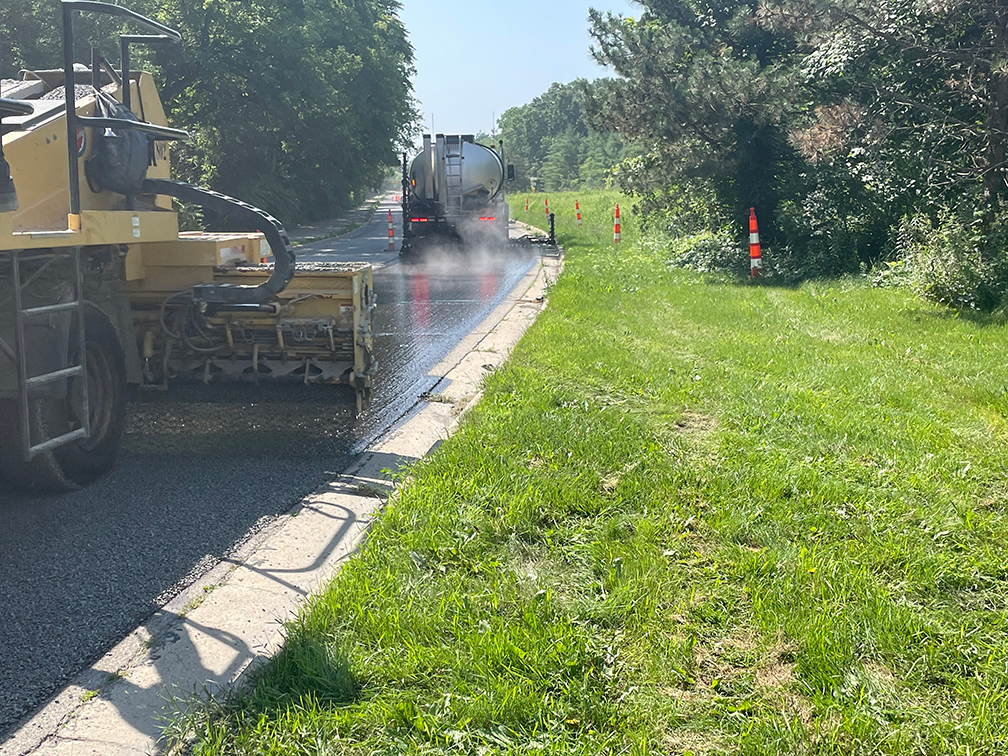
    • First, chip seal will be applied to the existing asphalt which takes about 1-2 hours. Road reopened once placement is done. 
      • Street sweeping will occur between treatments.
    • Second, micro-surfacing will be applied over the chip seal which takes about 2-3 hours, temperature dependent. Road reopened once completed and material has set.
      • Street sweeping is scheduled about 1-2  weeks post final treatment. This is intentional to allow vehicle traffic to assist in compacting and imbedding the aggregate into the micro-surface and create the seal that will protect the existing asphalt. 
  • Pavement markings re-applied. 
  • Project area clean up and final street sweeping. 

Neighborhood Construction Impacts

  • Loose stone is normal and it is recommended to drive slow to not damage the pavement.
  • Mail delivery will be maintained. 
  • Trash, Recycling, and Compost binds are required to be clearly marked with your address and placed in the lawn extension (not in the road) the night before your scheduled collection day to accommodate construction. 
  • Vehicle access will be periodically delayed during construction. If your vehicle is needed park legally, on an adjacent street, outside of the construction area during working hours. 
  • Door notices will be provided in advance of chip seal and micro-surfacing operations. 

Preventative treatments are applied to asphalt roads in fairly good condition and over the existing asphalt. 

Cape Seal

Two-step process consisting of Chip Sealing followed by Micro-Surfacing (does not happen on the same day).

Step 1: Chip seal consists of applying a thin layer of liquid asphalt over existing pavement to fill the cracks and voids followed by a layer of aggregate (chips). A rubber-tired roller is used to compact and embed the chips into the liquid asphalt. Process typically takes 1-2 hours.

Step 2: Micro-Surfacing typically happens 1 to 14 days after the chip seal has been applied and consists of applying one to two courses of a cold mixture of asphalt, fine aggregates, cement, water and other additives over the chip seal or existing asphalt. Typical thickness is 3/8 to 1/2 inch. Process typically takes 2-3 hours, temperature dependent. 

Crack Seal

Consists of filling and sealing existing cracks typically in asphalt pavement with hot-rubberized asphalt. 

Project Areas

Anticipated Pavement Preservation Streets for the 2026 construction season will be posted in January-February and will be shown in yellow on the Active Road and Utility Projects Dashboard.

All work is anticipated and subjected to change due to weather or conflicts. Updates will be posted as soon as a new schedule has been determined. 

Contractor's schedule website.

West Liberty Street from Scio Ridge to Crest

Anticipated to Start the Week of August 24 - Final Pavement Markings 

Newport Road from M-14 bridge deck to City Limits 

Anticipated to Start the Week of August 24 - Final Pavement Markings


All work is subjected to change due to weather and/or scheduling conflicts. If delays occur, please have patience while the new schedule is finalized and posted. 

Any work that results in road or lane closures will be posted online. In addition, anyone can sign up to receive email and/or text alerts when new closures are announced.

Area 1 Street(s):

Arbana Drive from West Huron to Arborview 

Linda Vista Street from Linwood to Arborview 

North Revena Boulevard from Linwood to Harbrooke

South Revena Boulevard from West Huron Street to south end

Pine Ridge Boulevard from Dexter Avenue to north end

Wildwood Avenue from Dexter Avenue to Linwood

Anticipated Schedule:

Anticipated to Start the Week of August 24 - Final Pavement Markings


All work is subjected to change due to weather and/or scheduling conflicts. If delays occur, please have patience while the new schedule is finalized and posted. 

Area(s) 2 and 3 Street(s):

Longman Lane from Jackson Place to Fairview

Wordon Avenue from Jackson Place to Dexter Avenue 

Orchard Street from Glendale to Virginia 

Thaler Avenue from Burwood to Carolina

Virginia Avenue from Fair to Jackson Avenue

Anticipated Schedule:

Anticipated to Start the Week of August 24 - Final Pavement Markings


All work is subjected to change due to weather and/or scheduling conflicts. If delays occur, please have patience while the new schedule is finalized and posted.