
Maintenance and Capital Improvements

On this page:
Park Maintenance and Capital Improvements Millage 2025-2044
In November 2024, Ann Arbor voters approved to continue to support the principal funding source for park system capital improvements, repairs and restoration programs through 2044.
Learn more about the park millage for 2025-2044
-
FYI on CTN Ann Arbor interviewed Parks & Recreation Manager Josh Landefeld about the park millage - how millage funds maintain and keep Ann Arbor parks safe, up to date and vibrant for all.
-
Spend (less than) a minute with us! Watch the park vignette video features, produced by Ann Arbor Community Television Network
-
June 13, 2024, news release: Ann Arbor Parks & Recreation Millage to Appear on Nov. 5 General Election Ballot
-
Park maintenance and capital improvements funding distribution guidelines (PDF)
2025–2044 Park Maintenance and Capital Improvements Millage FAQs
What is the Park Maintenance and Capital Improvements Millage? What services does it support?
A: The Park Maintenance and Capital Improvements Millage, for 1.10 mills, was first approved by residents of the city of Ann Arbor during the Nov. 7, 2006, election. The current millage expires in 2024. The Park Maintenance and Capital Improvements Millage Renewal Proposal is a 20-year millage, also for 1.10 mills. The renewed millage would cover 2025–2044. This renewal is not an increase, the rate remains the same as the expiring millage. It is estimated that total revenue in the first year of the renewed millage, if approved, would be $8,519,150. Subsequent annual revenue would be adjusted based on the Headlee rollback (PDF) and property value adjustments. (One mill is equal to 1/1,000 of a dollar. Or, more simply, for every $1,000 in taxable value, a property owner will pay $1 in property tax.)
The millage funds the following Ann Arbor Parks & Recreation activities:
-
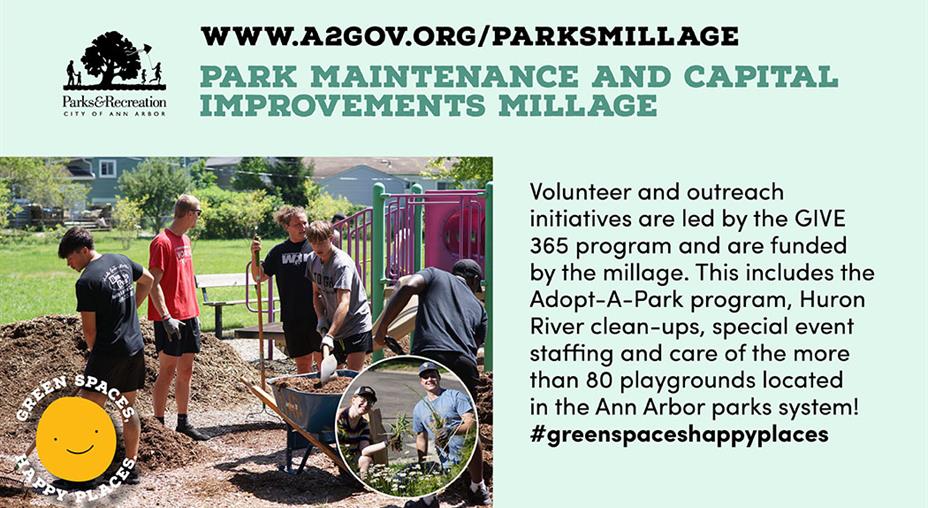
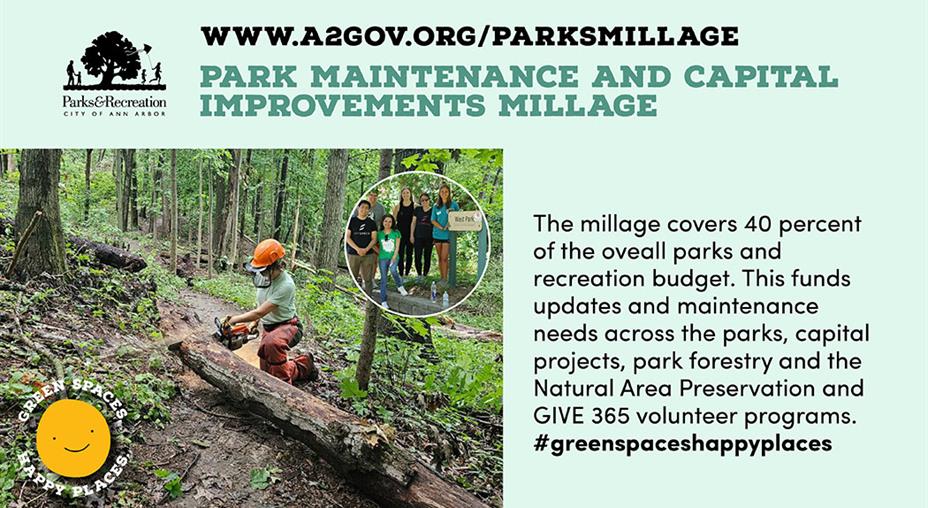
Between 60% and 80% of the annual millage funds support city park maintenance activities. Park maintenance activities include natural area preservation, general and seasonal maintenance of parks, courts, playgrounds, equipment, amenities, forestry and horticulture, volunteer outreach and recreation facilities.
-
Between 20% and 40% of the annual millage funds are designated for city park capital (larger-scale) improvements in the following areas: community-wide parks; park shelters and structures; historic preservation; neighborhood parks and urban plazas; pathways, trails, boardwalks, Border-to-Border Trail, recreation facilities; recreational dams; and major park equipment.
How much does the Park Maintenance and Capital Improvements Millage Renewal cost a property owner on an annual basis? How much does the expiring millage cost a property owner?
A: The Park Maintenance and Capital Improvements Millage Renewal annual cost to a homeowner based on an average taxable value of $176,933 is expected to be $195 for fiscal year 2026. The current cost to a homeowner based on an average taxable value of $176,933 for the expiring millage for fiscal year 2025 is $190 (FY2025 begins July 1, 2024). With 163 Ann Arbor parks, this equates to $1.19 per Ann Arbor park per household.
Why did the city ask for a 20-year millage renewal?
A: The City of Ann Arbor has had a park maintenance millage since 1983 and the current millage since 2006. Over the last 18 years, the current millage has primarily focused on park operation and ongoing maintenance and has been widely supported as a way to address ongoing maintenance, park operations and regular capital improvements. Moving to a 20-year renewal would allow staff to identify, secure and leverage alternative funding sources to accomplish a more holistic, strategic and long-term approach to planning.
A 20-year millage would position the city for the opportunity to bond against the remaining capital portion of the millage to potentially address more or larger projects in a shorter period. In addition to the potential to bond, parks staff would evaluate other funding opportunities such as a parks foundation, planned giving and other significant means to address any anticipated funding gaps for capital project needs. Because planning for these opportunities requires significant staff resources and attention, a longer millage would allow for more time to develop these alternatives while maintaining the level of service the community expects for maintenance and operations.
Does the Ann Arbor Park Maintenance and Capital Improvements Millage cover all improvement costs?
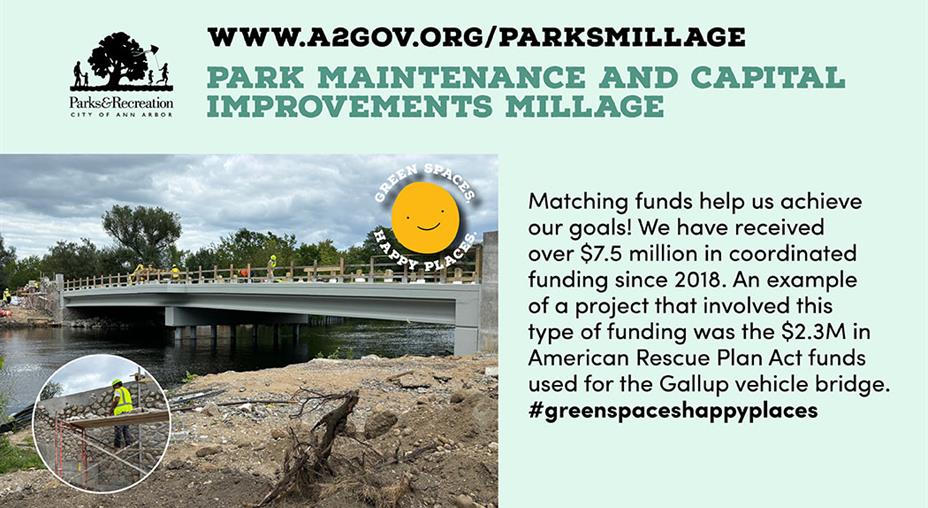
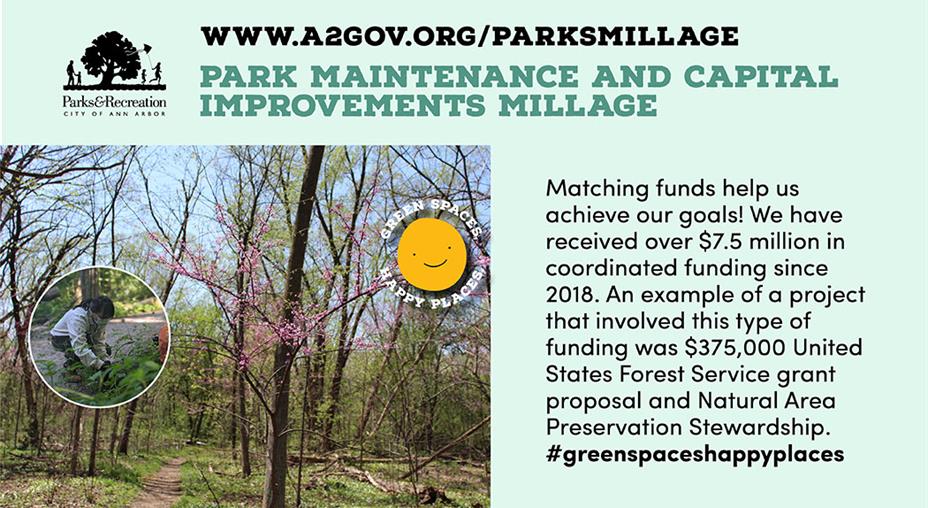
A: While a millage does not solely fund all maintenance and capital improvement needs for our vast parks system and its aging infrastructure, having a millage in place positions the city to seek additional funding to support necessary projects. In recent years, parks have received state (MDNR, EGLE) grants, federal (ARPA, US Forest Service grant) funding, private donations, local and foundation grants, cost-sharing partnerships, and cross governmental partnerships to complete many of our larger projects and support programming. Millage dollars are also often used as matching for certain grants. Some examples of this include:
-
Gallup Vehicular Bridge - $2.3 million in ARPA funds
-
Barton Bandemer Tunnel - Estimated budget of $6 million; due to cost-sharing agreement, the city is only responsible for one third, or an estimated $2 million.
-
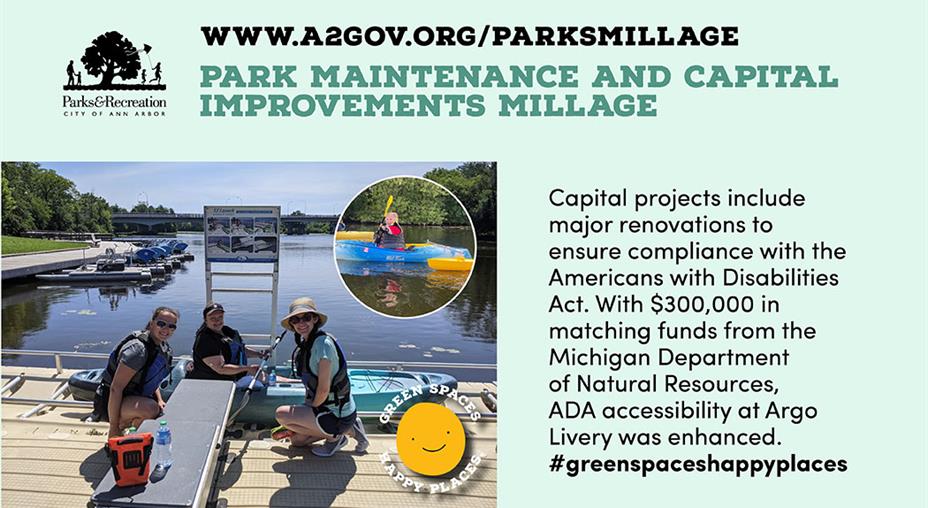
Argo ADA accessibility improvements - $300,000, received from MDNR
-
Skatepark lighting - $30,000, received from Washtenaw County
-
Solar panels at various facilities - Paid for by Ann Arbor Office of Sustainability and Innovations (OSI) budget
-
AmeriCorps interns
-
NAP grants - NAP worked collaboratively with city forestry and OSI to submit a $1 million U.S. Forest Service grant proposal for urban canopy management.
-
GIVE 365 watershed grants - $14,639.00 from The State of Michigan
-
Gallup Park path improvement from Gallup Bridge to Mitchell Field Bridge - Project cost $646,595.50; shared cost between Washtenaw County Parks and Recreation Commission ($115,000), and Huron Waterloo Pathways Initiative ($50,000)
What makes up the City of Ann Arbor park system?
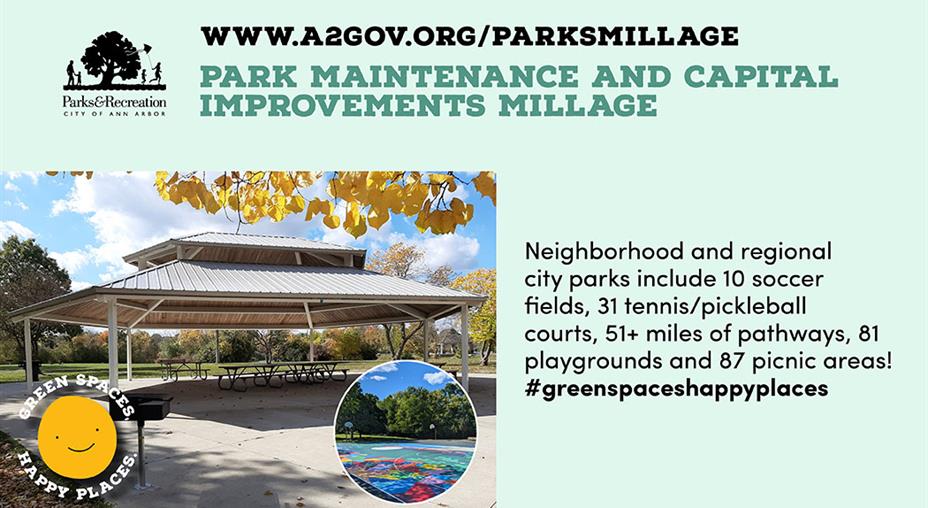
A: City parks, recreation and open space holdings are comprised of 163 parks and facilities, totaling approximately 2,200 acres of land. The properties include approximately:
-
492 turf acres
-
48 buildings
-
34 ball diamonds
-
31 tennis and/or pickleball courts
-
10 soccer fields
-
78 playground areas
-
87 picnic areas
-
52 miles of multi-use paths
-
50 miles of nature trails
-
4 swimming pools
-
2 artificial ice rinks
-
Hiking and nature trails
-
2 18-hole golf courses
-
2 canoe liveries
-
1 skatepark
-
1 farmers market
Over 50 percent of the land is unstructured and serves as open space, with approximately 700 acres of woodlands, 500 acres of shrub lands, old fields and pine plantations, and 200 acres of wetlands, savannas and prairies. Additionally, some 800 acres of Huron River water surface are accessible with strategically located boat launching sites. Special facilities include a senior center, two community centers, historic houses and the farmers market.
What are some examples of capital projects that have taken place in the parks over the last six years? What are examples of capital projects that might take place over the next six years?
A: Recent projects:
- Ann Arbor Skatepark - Skatepark lighting
- Argo Canoe Livery - Americans with Disability Act (ADA) accessibility improvements and restroom renovation and expansion
- Bandemer Park - Bridge repairs, Barton/Bandemer Pedestrian Tunnel Feasibility Study and design engineering
-
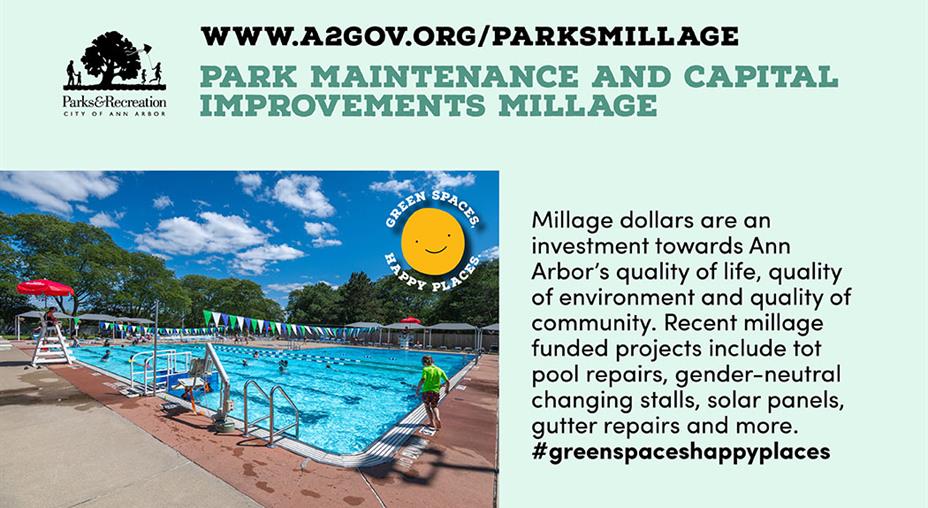
Buhr Pool - UV filtration system, tot pool repairs, gender neutral changing stalls, solar panels
-
Cobblestone Farm Barn - Generator, solar panels
-
Farmers Market - Gutter repairs, restroom renovation, winterization study
-
Fuller Pool - UV filtration system, additional shade structures, camp sheds, solar panels
-
Gallup Canoe Livery - New pergolas, replacement boats, solar panels
-
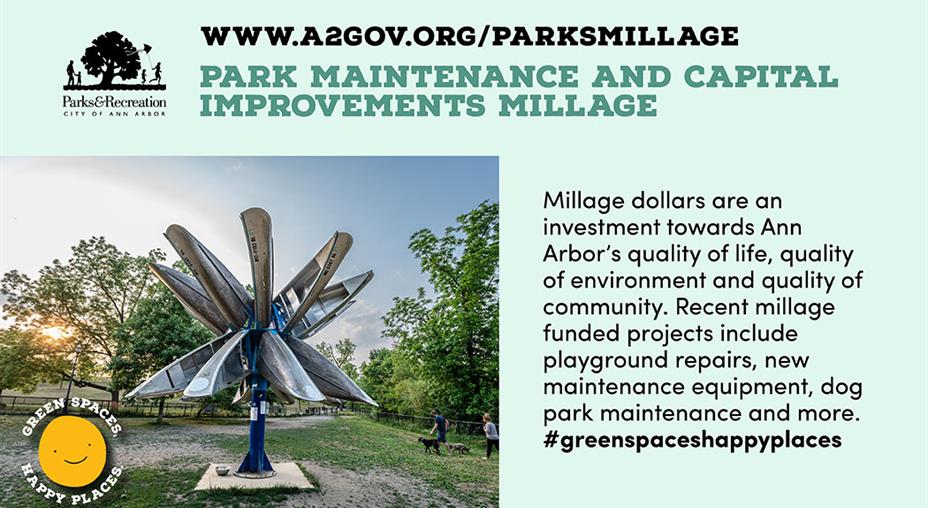
Gallup Park - Gallup vehicle bridge study and replacement, Universal Access Playground repairs, sink hole repair
-
Huron Hills Golf Course - New maintenance equipment, solar panels
-
Leslie Park Golf Course - New maintenance equipment, solar panels
-
Leslie Science & Nature Center - Nature playground, remediation
-
Mack Pool - UV filtration system, gender neutral changing stalls
-
Senior Center - New roof and kitchen and main room renovations
-
Veterans Memorial Park Ice Arena - Exterior wall repairs, rink surround flooring
-
Veterans Memorial Park Pool - UV filtration system, water slide repairs
-
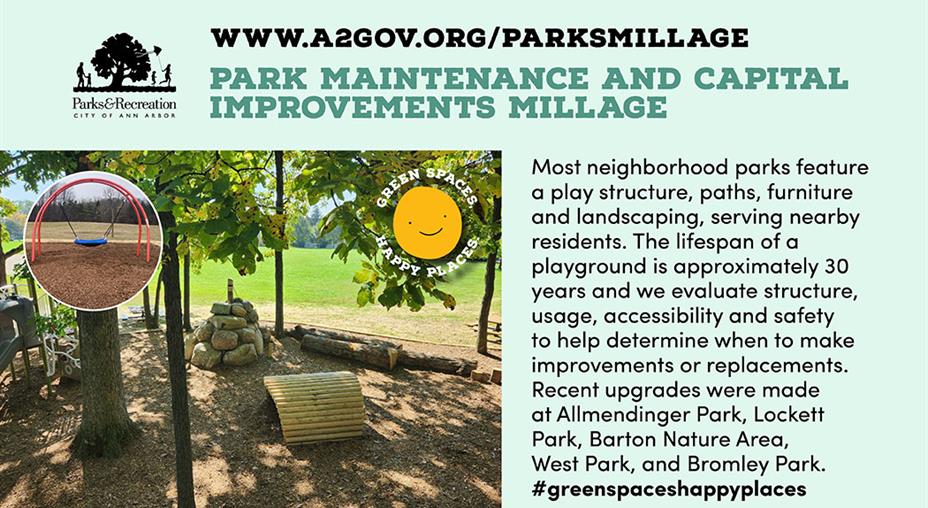
Neighborhood park playground area renovations have included: Allmendinger Park, Lockett Park, Barton Nature Area, West Park and Bromley Park.
-
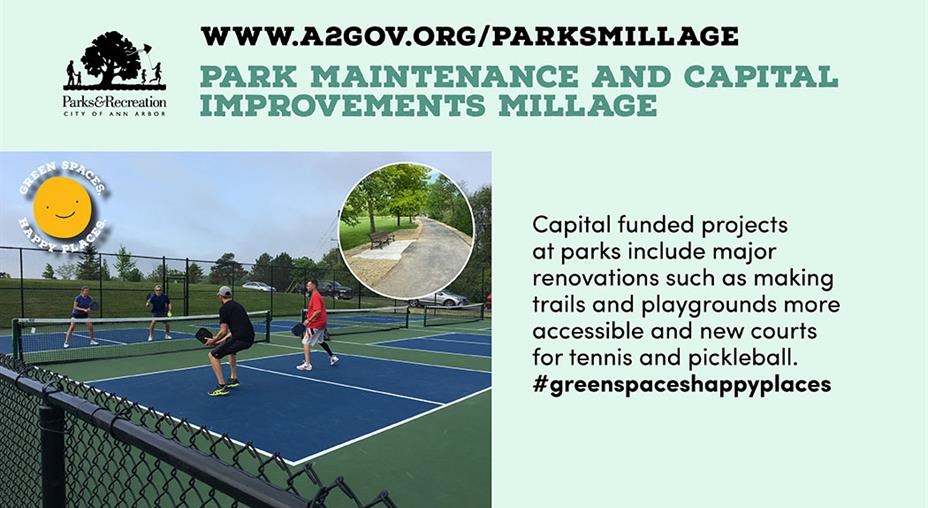
Game court (basketball, tennis and pickleball) renovations and reconstructions have included: Burns Park, Leslie Park and Southeast Area Park (recently renamed Bicentennial Park)
-
Pathway renovations: Riverside Park, Gallup Park, Plymouth Parkway Park, Border-to-Border Trail segments - Mitchell Field bridge to Gallup Park vehicle bridge, new Border-to-Border Trail pathway in Barton Nature Area
Comprehensive Americans with Disability Act (ADA) Transition plan:
Upcoming/under-construction projects: Listed below are some of the projects that are currently under construction or planned over the next few years. Some of expiring-millage funding has been set aside for these projects, and staff continues to seek alternative funding sources to support them. Many of the projects listed below require partners or additional funding sources to complete due to the size and scope of work.
-
Comprehensive capital assessment study
-
Barton Bandemer Tunnel
-
Bridge repairs at Leslie Golf Course and Sylvan Park
-
Ann Arbor Farmers Market office building
-
South Maple Park tennis/pickleball courts
-
West Park bandshell
-
2570 Dexter Road Park development
-
Ongoing neighborhood park playground renovations and upgrades
-
Ongoing mechanical upgrades at city pools and rinks
-
Ongoing bridge repairs and inspections
-
Ongoing trail, park road and parking lot renovations
Every year, additional neighborhood park improvements, game court replacements, recreation facility improvements and pathway improvements are identified as upcoming projects. For a more comprehensive listing of how the expiring millage has been used over the last six years, please see the "millage-funded projects and activities" section further down this page.
How does the city decide which parks/recreation facilities get millage funds for projects?
A: There are a variety of ways that staff identifies park projects, improvements and repairs, including: A2 Fix It service requests, Ann Arbor Capital Improvement Plan, routine inspections, routine maintenance, recently completed ADA study and the upcoming comprehensive capital asset assessment. Each of these methods helps identify what needs to be done, ranging from immediate attention needed to long term. Staff then evaluates each project with the following criteria — safety concerns, equity of amenities across city, cost of repair, and amount of use, to name a few — then prioritizes and begins to schedule projects accordingly. In addition to addressing safety issues, other projects require immediate attention/repairs also to maintain operations or prevent long-term or worsening damage. When these situations occur, the priority list and future schedule are often adjusted due to available resources including millage funds and staff time.
How do I find out the millage has provided support to my neighborhood park, favorite recreation facility or favorite nature area — how do I do that?
A: Parks staff has maintained a table detailing work activities at city parks throughout the life of the millage(s). The table is arranged alphabetically by park name and lists park development, maintenance and improvement projects funded through the expiring millage(s). View the table(s) posted in the "millage-funded projects and activities" section further down this page.
Is funding for Ann Arbor Natural Area Preservation (NAP) part of the proposed millage renewal? What is NAP's mission?
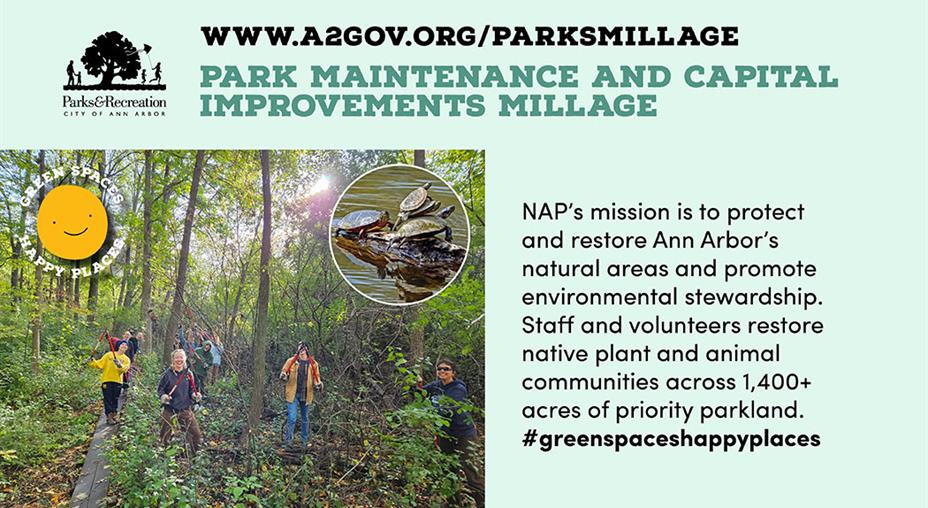
A: Yes. Over 50% of the city park system is made up of natural park areas. The Natural Area Preservation (NAP) unit of parks and recreation is responsible for the care and maintenance of 1,400 acres of natural areas across the park system. NAP's annual operating budget is approximately $1.1 million and is entirely funded through the expiring millage. The millage renewal would continue to fund NAP.
NAP's mission is to protect and restore Ann Arbor's natural areas, and to foster an environmental ethic within the community. NAP staff and volunteers achieve this by conducting a wide range of ecological stewardship activities to restore the native plant and animal communities throughout the Ann Arbor park system. Stewardship activities include prescribed fire, invasive species removal and trail maintenance. These activities are prioritized by ecological health assessments of individual sites, their context within the park system and volunteer interest.
Is the Park Maintenance and Capital Improvements Millage used to purchase new parkland?
A: No. The millage cannot be used to purchase new parkland. In November 2003, residents of Ann Arbor approved a separate 30-year Open Space & Parkland Preservation (also known as the "Greenbelt") millage for the sole purpose of purchasing parkland and preserving agricultural land.
Are there guidelines for the administration of the millage renewal?
A: Yes, City Council approved policies for the administration of the expiring Park Maintenance and Capital Improvements millage on Aug. 21, 2006, and approved an amended policy on May 16, 2016. City Council approved reaffirming these policies for administration for the millage renewal at their June 3, 2024, meeting. The administrative policy guidelines are:
-
Adoption of the Funding Distribution Guidelines as stipulated in Attachment A (PDF)
-
Annual allocation for maintenance is to be between 60% and 80%, and capital improvements allocation is to be between 20% and 40%, with a total annual allocation being 100%.
-
Parks and recreation system activities can be funded by funds other than the city's general fund and millage to maintain fiscal year 2011 level of service, and for the purpose of this resolution, all funds other than the millage which are used to support parks and recreation system activities shall be considered the same as city's general fund support.
-
The Natural Area Preservation program budget be established at a minimum of $700,000 for the first year of the millage budget, and that its budget be reflective of its proportionate share of the increase or decrease in revenue recognized from the Park Maintenance and Capital Improvements Millage proceeds
-
If future reductions are necessary in the city's general fund budget, during any of the six years of this millage, beginning with fiscal year 2019–2020, the general fund budget supporting the parks and recreation system for that year will be reduced by a percentage no greater than the average percentage reduction of the total city general fund budget.
-
If future increases occur in the city's general fund budget during any of the six years of this millage, beginning with fiscal year 2019–2020, the general fund budget supporting the parks and recreation system for that year will be increased at the same rate as the average percentage increase of the total city general fund budget.
-
City Council will verify these expenditures by examining the audit statement for each year.
-
The millage will not be subject to a municipal service charge.
-
The millage may be subject to appropriate information technology and fleet charges.
-
If the millage is not renewed after the six years, the Natural Area Preservation program will receive the same percentage of any remaining fund balance from the Park Maintenance and Capital Improvements Millage as was in the approved budget in the sixth year of the millage; and
RESOLVED, That the city administrator be directed to develop an annual millage budget for review and recommendation by the Park Advisory Commission with final adoption by City Council consistent with this resolution.
The administrative policy mentions funding distribution guidelines. What are those?
A: Attachment A (PDF) lists activities that can be funded from the millage, general fund, or both. Annual allocation for maintenance is to be between 60% and 80%, and capital improvements is to be between 20% and 40%, with a total annual allocation being 100%. Park maintenance activities include:
-
Natural area preservation
-
General maintenance of parks, courts, playgrounds, equipment, amenities
-
Forestry and horticulture
-
Volunteer outreach
-
Recreation facilities maintenance
Between 20% and 40% of the annual millage funds are designated for city park capital improvements in the following areas:
-
Community-wide parks
-
Park shelters and structures
-
Historic preservation
-
Neighborhood parks and urban plazas
-
Pathways, trails, boardwalks, Border-to-Border Trail
-
Recreation facilities
-
Recreational dams
-
Major park and/or facility equipment
The funding distribution guidelines were developed in 2006 to address the purpose of the general fund related to parks and concerns regarding reductions in the general fund. As a result, activities such as mowing, litter and refuse collection, sidewalk/pathway/parking lot snow and ice control maintenance, and utility costs were identified as basic activities to be funded solely from the general fund and deemed ineligible for millage funding. Additionally, staffing for recreation facility operations and programs at the following recreation facilities is primarily funded through the general fund: Mack, Fuller, Buhr and Veterans Memorial park pools; Argo and Gallup canoe liveries; Leslie and Huron Hills golf courses; Ann Arbor Farmers Market; Veterans Memorial Park and Buhr Park ice arenas; Cobblestone Farm; and the Ann Arbor Senior Center.
If I have questions how can I contact you?
A: Please email us at a2parks@a2gov.org, and we will be sure to respond to your questions!
Current and Past Millage Resources
Park Millage Renewal for 2019-2024 Approved
City of Ann Arbor voters approved a six-year park millage in November 2006, and renewed for another six years in November 2012, to fund current, ongoing improvements to Ann Arbor’s park system, which consists of 161 parks spanning more than 2,188 acres. On Tuesday, Nov. 6, 2018, voters again approved the renewal of the city's parks maintenance and capital improvements millage at the rate of 1.1 mills.
Millage Impacts
Between 60% and 80% of the annual millage funds support city park maintenance activities. Park maintenance activities include forestry and horticulture, natural area preservation, park operations, park equipment repairs, and recreation facility maintenance. Between 20% and 40% of the annual millage funds are designated for City park capital improvements in the following areas: active parks; forestry and horticulture; historic preservation; neighborhood parks and urban plazas; pathways, trails, boardwalks, greenways and the Huron River watershed; recreation facilities; and park equipment acquisitions.
The millage renewal equates to 1.10 mills and estimates total revenue in the first year of the millage of $6,042,300. The estimated annual cost to a household in the first year of the millage renewal, based on a mean taxable value of $126,628 is expected to be $139.29. The current cost to a household for the expiring millage based on a mean taxable value of $126,628 is $136.26.
If you have questions regarding the millage please contact us at a2parks@a2gov.org.
Documents
Millage Videos
Did you Know?
Ann Arbor has 163+ parks - many with unique features. Watch this video to learn about some of our most popular and special amenities in the park system.
Did you Know?
Millage-funded Projects and Activities: Through Present
The tables below list park development, maintenance, and improvement projects funded through this millage; the fiscal year (FY) in which the improvement occurred is indicated. Also indicated on the tables are park improvements made possible through other funding sources, as specified.
- Current 2026 park system projects
- COMPILED list of park system projects, for fiscal year 2008 to 2024
-
Status table, for fiscal year 2024 (posted May 2024)
- Status table, for fiscal year 2019 (PDF)
 734.794.6230


