-
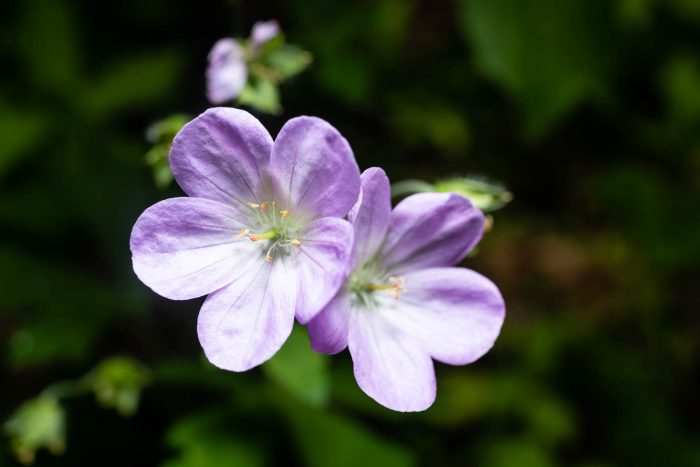
Incorporate more native plants into your garden beds. Our native pollinators have evolved to survive on native plant species, and often are ill-equipped to make use of non-native plant species like turfgrass. Plus, native plants are adapted to our local environment and are easy to care for once established. Looking for advice on native plant species to include? Check out NAP’s lists of native plants, especially their native perennials list, and this article on Bringing Native Plants into Formal Garden Design from the Matthaei Botanical Gardens and Nichols Arboretum.
-
The more native, pollinator-friendly plants are in your yard, the more habitat, landing space, and food is available for our pollinators, who can make only minimal use of turfgrass.
-
Delay spring clean-up until temperatures are consistently at 50F overnight; leave stems, grass clippings, and last year’s plant debris around for pollinator habitat.
-
Leave whole or mulched leaves in your yard during the fall and winter. These leaves provide invaluable habitat for pollinator species, especially for overwintering eggs and adults. However, please do clean up leaves near streets and sidewalks, since these leaves can cause slipping hazards and block storm drains.
Pollinator-Aware Yard Care
Protecting biodiversity through native plantings, reduced mowing, and more.

Register, Request a Yard Sign, and Subscribe
Want to register your yard as a participant in the Pollinator-Aware Yard Care program and request a yard sign? Interested in updates about the program, opportunities to get discounts on native plants, and information on how to protect pollinators? Or want to sign up for OSI's monthly newsletter? Use these buttons to get involved!
Register as a Participant & Request a Yard Sign Subscribe to Email Updates About PAYC Sign Up to Receive OSI's Monthly Newsletter
Gas Leaf Blower Phase-Out: In December 2023, Ann Arbor City Council passed new restrictions on the use of gas-powered leaf blowers within Ann Arbor city limits. Currently, the use of gas-powered leaf blowers is prohibited in Ann Arbor from June 1st to September 30th. Beginning January 1st, 2028, the use of gas-powered leaf blowers will be prohibited year-round in Ann Arbor. The purpose of this ordinance is to protect the peace, health, safety, and welfare of persons in Ann Arbor as well as to promote the City's sustainability goals.
A great alternative to gas leaf blowing is to skip leaf blowing all together! Leaving whole or mulched leaves on your lawn provides a much-needed habitat for pollinator species. If you also use your leaf blower to remove mowed grass from the sidewalk, you can reduce the area of mowed turfgrass on your lawn by planting native groundcover in place of turfgrass or by extending the area of your garden beds.
If you are interested in learning more about the leaf blower ordinance, alternatives to gas leaf blowers, and how to sustainably dispose of gas leaf blowers, check out our gas leaf blower phase-out webpage.
Welcome
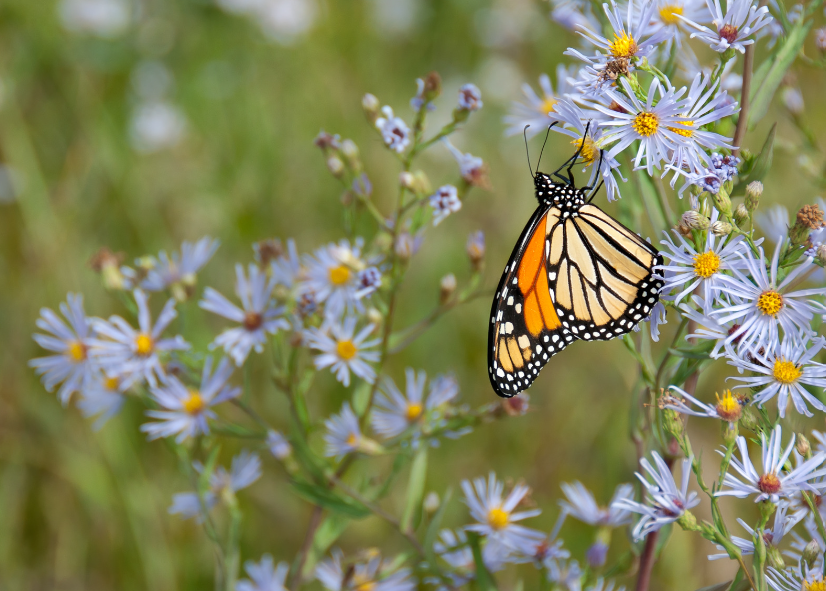
Around 75 percent of all plants rely on pollinators such as butterflies, bees, and beetles to spread their pollen. Pollinators are a key part of a healthy ecosystem. Without them, we wouldn't have plants to prevent soil erosion, remove carbon from the air, and provide homes for wildlife. But, native pollinators are struggling. Threats to pollinators include pesticides that kill them, herbicides that kill their food, habitat loss, disease, and climate change.
In April 2023, Ann Arbor City Council approved Resolution R-23-111 - Resolution to Support Pollinator Habitat in Ann Arbor, which encourages property owners to adopt lawn care strategies that will help support survival of pollinators. This resolution led to the development of the Pollinator-Aware Yard Care program, which provides resources for property owners to implement yard care practices that promote native pollinators. This work is supported by City staff and by volunteer members of the Ann Arbor Environmental Commission.
Want a summary of Pollinator Aware Yard Care? Check out Episode 4 of Green Light to learn all about the program!
Why Use Pollinator-Aware Yard Care Practices?
There are many benefits to following pollinator-aware yard care practices and planting native plant species. Some of these benefits are listed below:
-
Pollinators help to put food on the table. They fertilize flowers that develop into food for both people and animals.
-
30% of all Michigan crops and 90% of Michigan wild plants rely on pollinators (Michigan Department of Transportation). Worldwide, 35% of crops are reliant on pollinator activity (Michigan Department of Agriculture and Rural Development).
-
The USDA estimates that crops dependent on pollination are worth >$18B/year.
-
Native plant species help to increase stormwater infiltration to improve water quality and avoid flooding, as compared to turfgrass.
-
Native plant species don't rely on lawn mowers for maintenance, meaning you'll cut down on the noise pollution and soil compaction caused by lawn mowers, as well as the carbon emissions of fossil fuel-based lawn mowers.
-
Supporting a wide variety of pollinators and native plants increases biodiversity, which is essential to healthy ecosystems and the services they provide.

How to be Pollinator-Aware in Your Yard
There are many pollinator-aware yard care practices that you can follow in order to participate in this program. Below are a few recommendations on yard care practices to help you get started with protecting pollinators in your yard:
-
Reduce the area of mowed turfgrass in your yard by extending your maintained garden beds or by planting native groundcover in place of turfgrass (check out Natural Area Preservation (NAP)'s list of native grasses, rushes, and sedges for alternative groundcover ideas).
-
Reducing the area of mowed turfgrass around the base of your trees can help protect the trees from mechanical damage from mowers.
-
Research has shown that reducing mowing frequency can increase biodiversity and support pollinator species. Mow turfgrass portions of your yard less frequently and set your mower to cut grass to a taller height. Taller grass can provide more habitat for pollinator species and may be better able to withstand drought conditions. In addition, less frequent mowing can allow for pollinator-friendly plant species mixed into the turfgrass to bloom and provide a food source for pollinators. Please note that cutting grass height down by more than about one third to one half of the blade can damage the grass.
-
As an alternative to reducing the area of mowed turfgrass in your yard, try adding a clover mix to your turfgrass areas - this will add diversity that benefits pollinators and will add nutrients to your soil, helping to make your turfgrass healthier without chemical inputs!
-
Reduce or avoid chemical applications, especially of neonicotinoid insecticides. To avoid adding plants pre-treated with these chemicals, ask your nursery before purchasing any plants. Chemicals can harm native plant and pollinator species, in addition to leaching into our soil, groundwater, and waterways. Learn more about chemical-free pest management solutions on our Integrated Pest Management page.
-
Use non-toxic gardening methods. Herbicides can reduce pollinator food sources, and fungicides can be toxic to pollinators. If you see some holes in your plant leaves, that may be a good sign of caterpillar foraging. Watch for the next stages of caterpillars and chrysalis on plants, followed by butterflies! Stop and think before you spray anything outdoors.
-
Neonicotinoids are found in the following active ingredients: acetamiprid, clothianidin, dinotefuran, imidacloprid, nitenpyram, nithiazine, thiacloprid, thiamethoxam, cycloxaprid, imidaclothiz, paichongding, sulfoxaflor, guadipyr, and flupyradifurone.
-
Pollination happens at night as well as during the daytime. You can help nocturnal pollinators (such as moths) and improve bird safety by reducing your light pollution.
-
Turn off exterior lights when possible, and shade windows in lighted rooms at night. If you must use outdoor lights, use dim, shielded, downward pointing, motion activated lights, with a warm yellow-red color temperature. All of these options reduce light-induced distraction of night time insects, birds, and other animals.
-
All exterior lighting must adhere to Ann Arbor's Unified Development Code, Chapter 55, Section 5:25.
-
Use electric, rather than gas-powered, lawn care equipment to reduce pollution and greenhouse gas emissions. The City of Ann Arbor prohibits the use of gas-powered leaf blowers from June 1st to September 30th of each calendar year. Beginning January 1st, 2028, the use of gas-powered leaf blowers will be prohibited year-round.
-
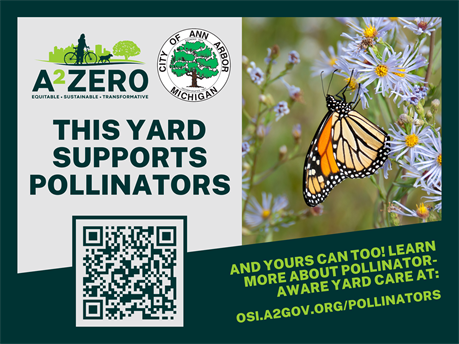
Use signage to help communicate the yard care practices you use and their associated benefits with neighbors and others who may be admiring your pollinator-friendly yard. Interested in receiving a yard sign to let others know you’re part of the Pollinator-Aware Yard Care program? Find a link to sign up for yard signs and email updates in our “Get Involved” section below. Please note that yard signs may not be placed on the lawn extension, per Chapter 55, Section 5.24.3(H). For guidelines on sign placement, please view our Guide to Temporary Signs in the City of Ann Arbor.
-
Consider keeping trimmed borders near sidewalks to keep the walkway clear and send a visual cue that any tall vegetation in your yard is intentional.
-
Ensure all of your plantings adhere to Ann Arbor City Code, Chapter 40, Sections 3:15 (Lawn extension and city right-of-way) and 3:16 (Vegetation on private property).
-
Tell your landlord or HOA to create pollinator-friendly habitats and maintenance policies.
-
Share this webpage with your friends, family, and neighbors.
-
Keep in mind that it doesn’t have to be all or nothing! Pick and choose the yard care practices that work best for you - or identify sections of your yard in which to adopt these practices.
Download this template email that can be sent to your landlord or property manager to encourage them to adopt PAYC practices - you can customize this email to your specific concerns, with example language provided for a few of the main concerns you may have!
Looking for more inspiration? Check out this guide of pollinator-friendly actions from the Xerces Society.
Choosing Native Plants
Lists of native plant species can be found on NAP’s Native Plants page - we recommend checking out the Native Perennials and Native Grasses, Rushes, and Sedges lists in particular when planting to support pollinators. See “Additional Resources” below for examples of local retail sources of native plants.
When planting native species, please keep in mind the need for species that are height-appropriate in our urban environment, specifically in lawn extensions and right-of-way areas. All of your plantings should adhere to Ann Arbor City Code, Chapter 40, Sections 3:15 (Lawn extension and city right-of-way) and 3:16 (Vegetation on private property). Please select shorter plants for your lawn extension, as tall plants can create safety hazards for pedestrians and bicyclists. Please grow tall species of plants on your private property (between the house and the sidewalk), in cultivated beds, or as part of a planned natural landscape, rather than in the lawn extension.
Examples of plants that may become too tall for lawn extensions include:
Sunflowers, Goldenrod (some species), Purple Coneflower, Joe-Pye Weed, Culver’s Root, Cup Plant, Big Bluestem, Cosmos, tomato plants, and some ornamental grasses.
Get Involved
Interested in participating in the Pollinator-Aware Yard Care movement? Click here to register your home address as a program participant, sign up for email updates, and/or request a yard sign to let everyone know that you’re a pollinator-aware home! Please note that yard signs may not be placed on the lawn extension, per Chapter 55, Section 5.24.3(H). For guidelines on sign placement, please view our Guide to Temporary Signs in the City of Ann Arbor.
Are you a renter who is interested in seeing more sustainable landscaping practices used on your property or in your rental community? Download this template email that can be sent to your landlord or property manager to encourage them to adopt PAYC practices - you can customize this email to your specific concerns, with example language provided for a few of the main concerns you may have!
Want to learn how to identify different species of plants, insects, birds, etc. - while also contributing your observations to a database that can be used for scientific research? Check out citizen science phone apps such as PlantNet and iNaturalist.
How is Ann Arbor Supporting Pollinators and Native Plants?
-
Trees, shrubs and flowering perennials in our City's natural areas and parks are host to many pollinator species. To learn more about Ann Arbor’s parks and natural areas, you can refer to the A-Z List or use the Park Finder.
-
Natural Area Preservation (NAP) does not use neonicotinoids to maintain City natural areas.
-
NAP is working to remove invasive species in natural areas and parks to allow for native plants to flourish. NAP relies on volunteers (groups and individuals) to complete a significant amount of the work.
-
NAP does annual surveys for breeding birds, frogs & toads, salamanders, turtles, and butterflies.
-
Learn more about sustainability initiatives in our Parks system here.
-
The Elizabeth Dean Trust Fund plants trees in Ann Arbor’s public areas (which includes parks and nature areas).
-
Mayor Taylor has signed on to the National Wildlife Federation's Mayors' Monarch Pledge and is taking action to protect monarch butterflies.
-
Ann Arbor and Washtenaw County are both certified as National Wildlife Federation Community Wildlife Habitats.
Additional Resources
-
City of Ann Arbor Water Resource’s Integrated Pest Management page
-
City of Ann Arbor Natural Area Preservation’s Native Plants page
-
Ann Arbor District Library's Seed Sampler Program
-
Washtenaw County Water Resources Rain Garden page
-
Washtenaw County Conservation District
-
Michigan DNR’s Monarchs in Michigan guide
-
Michigan State University Washtenaw County Extension Office
-
MSU Extension’s Smart Lawn Alternatives to Protect Pollinators and Native Bee Habitat Management Guide
-
The native pollinator plant finder tool from the National Wildlife Federation
-
The Michigan Botanical Society's Huron Valley Chapter
-
Local native plant nurseries, such as: Feral Flora, Michigan Wildflower Farm, Michiganese Natives, Nature & Nurture Seeds, New Leaf Natives, Wildtype Nursery, and Windy Rock Farm.
-
Organizations with local plant sales and events, such as: Matthaei Botanical Gardens and Washtenaw County Conservation District.
-
Companies that do native plant designs, planting, and restoration, such as: Adapt: Community Supported Ecology, Appel Environmental, Feral Flora, InSite Studio, Michiganese Natives, Nature & Nurture Seeds, Natural Community Services, Oak Arbor, Plantwise, and Wildtype.
-
Companies that provide lawn care services using electric equipment: A&H Lawn Service, Eco Lawns, Electric Lawn Company, MowGreenMow, and NetZero Tree and Lawn Care.
- Information about growing native plants from seed and seed distributions: Seeds to Community