
Ann Arbor Historic Preservation Awards presentation is July 20
The Ann Arbor Historic District Commission (HDC) will present the 39th annual Historic Preservation Awards during the Monday, July 20, City Council meeting, 7 p.m. at Larcom City Hall. The award recipients are being recognized for their contributions to the history of the city of Ann Arbor through their preservation efforts. There are 13 awards this year: five for preservation, two for rehabilitation, three special merit awards and three anniversary awards.
The Ann Arbor City Council meeting will air on Ann Arbor CTN (government channel), and the video featuring the awards presentation will later be available to watch via CTN on demand. Visit CTN online for details: https://www.a2gov.org/departments/communications/ctn/Pages/watch.aspx.
The HDC provides the descriptions for each winning building or project.
Preservation awards are presented in recognition of superior maintenance of a significant property to preserve its essential historical, cultural or architectural value for 10 years or more. The honorees are:
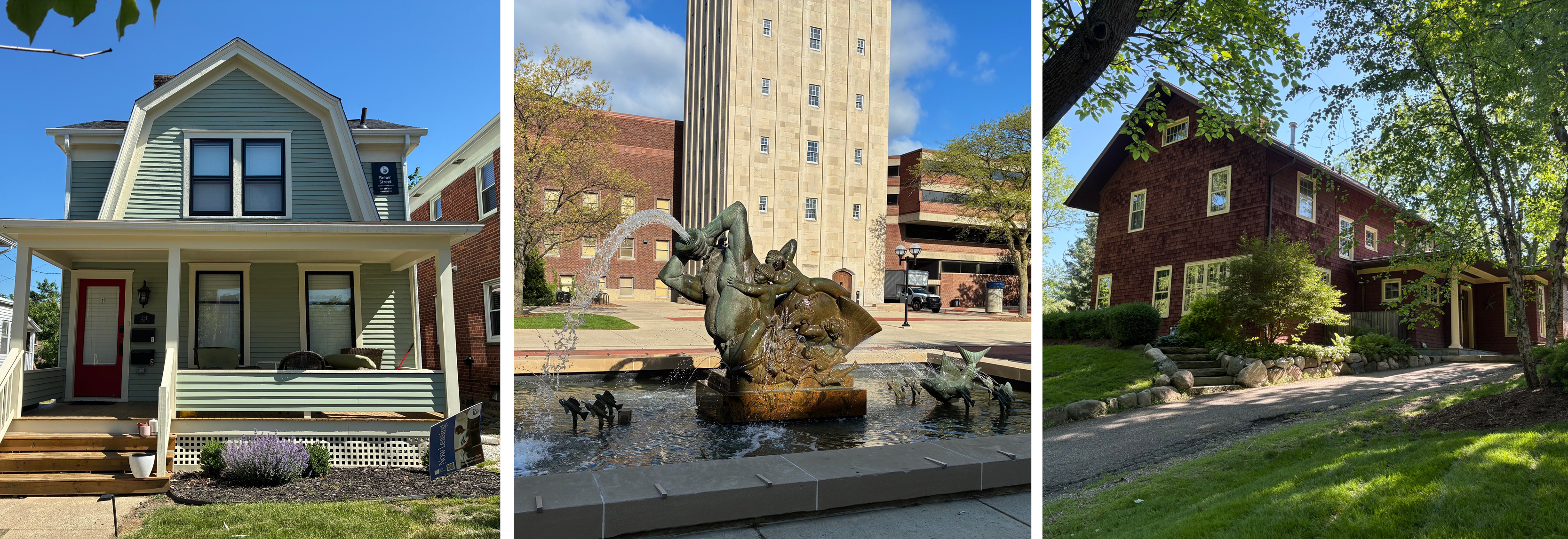
Cooley Fountain—Completed in 1940, the Cooley Memorial Fountain is located on the Ingalls Mall on the University of Michigan's Central Campus between the Michigan League and Burton Tower. The fountain features a bronze sculpture by renowned Swedish sculptor Carl Milles titled “Sunday Mornings in Deep Waters,” which depicts the sea god Triton with his sons and 13 smaller fish. Milles also designed sculptures on the campus of Cranbrook, where he taught in the winter months. He spent summers in Sweden, where many of his sculptures can be seen at his home and studio in Stockholm. The fountain was commissioned by university athletic director Charles Baird, who wanted to honor his childhood friend Thomas Cooley, a dean of the Law School. It was restored in 2018 by the SGH Group working with senior architect Michelle Smay from the university. This award is presented to the University of Michigan.
Palmer House, 227 Orchard Hills Drive—This iconic house, known as the Palmer House, was designed inside and out by Frank Lloyd Wright in 1952. It remained in the Palmer family until 2009, when it was sold to the current owners. At 74 years old, the house is remarkably unchanged, including the garden and the Chinese tea house in the backyard. The house is from Wright's Usonian period, when he designed small houses for mass consumption. It was built in a pattern of equilateral triangles by local builder Erwin Niethammer. These triangular shapes are repeated within the house in the furniture, tables, chairs, dishes, cutlery and concrete floors. Wright used Claycraft brick, perforated ceramic block and red tidewater cypress. Cantilevered roofs of cedar shingles shelter the house with deep overhangs. Most of the trims were painted Cherokee Red, Wright's color of choice. The owners have maintained the historic character of this house, one of the showplaces of Ann Arbor, and use it as a vacation rental with strict supervision. This award is presented to Jeffrey and Kathryn Schox.
1701 Morton Avenue—This 1945 Tudor was built by Mark Ross, president and treasurer of Midwest Furniture. He lived here with wife Martha and two children. By 1955, it was occupied by Samuel Hayes, professor of economics at the University of Michigan. In the 1960s, it was the home of David J. Birch, a professor of psychology, and from 1983-2005 it was the home of Professor Stephen Ramsburgh and his wife Ellen. It has been owned by the current owners since 2005. The house is defined by its parabolic arched doorway outlined in stone and set on an angle to the house, which gives this corner a unique configuration. Casement windows set into the brick also define the style, along with the copper-roofed bay window near the entrance. This award is presented to Michael Faulkner and Lisa Seyfried.
1444 Ferdon Road—This house was built in 1922 in an unusual mix of styles by Wilbert Heimerdinger, a local building contractor. He built this house with elements of the Craftsman, Bungalow and Prairie styles. It has a wraparound porch that is reminiscent of earlier Victorian houses with open porches. It also has a clipped gable dormer facing Ferdon, which provides a vertical element in a largely horizontal building. It uses three colors of brick and wide raking boards under the eaves, which add to a Craftsman effect. After the Heimerdinger’s, the house was occupied by Cornelius Modder, a co-owner of the Crane Coal Company. He sold the house to Professor of Psychology Clyde Coombs and his wife Lolagene, a professor and director of the University of Michigan's Population Studies Center. They in turn sold it to Louis Ferman, a professor of social work and a co-director of the university's Institute of Labor and Industrial Relations. He lived here from the 1950s until 1999. Since then, it has been owned by current owners who have maintained the exterior and added compatible landscape. This award is presented to Robert Axelrod and Amy Saldinger.
725 Arlington Boulevard—Built in 1925, when it was not yet part of Ann Arbor, this home had its address changed from 2910 Geddes Avenue to 725 Arlington Boulevard in response to a request by the owner in 1978. It was built by Clifton O. Carey, an associate professor in the Department of Engineering, reputedly as a rare Sears “Honor” kit house, which, according to kit house expert Andrew Muth, is known to have had only 12 built. With cedar shakes, eyebrow dormers and wood shutters, it has all the bells and whistles of a Craftsman home. Carey is listed in city directories as living in this house until he retired in 1945. It was the home of Neill and Carol Hollenshead from 1990 until it was purchased by the current owners in 2002. This award is presented to Andrew and Amy Shepherd.
Rehabilitation awards are presented to projects that have substantially returned a property to its historic condition. The honorees are:
520 South Ashley Street—This 1896 house was built by John Ziegler, a clerk at Dean and Company. It is a simple Queen Anne, L-shaped house with a wraparound porch. All the restoration carpentry was done by the current owners. It is in the Old West Side Historic District. This award is presented to Jay Simrod and Constance Crump.
331 East Ann Street—The house was probably built in the early 1830s as the wing of a house that was destroyed by fire circa 1913. The house was purchased in 1846 by William Loomis, a grocer, for $5,500, and it remained in the Loomis family until the 1920s. The gambrel roof facade was added in 1914. The current owner restored the original front porch and constructed a compatible rear addition that was approved by the Historic District Commission in 2023. It is in the Old Fourth Ward Historic District. This award is presented to Ryan Pantaleo.
Special merit awards are given in recognition of exceptional projects, landscapes or other unique preservation projects, including lifetime achievements. The honorees are:
Jones School Historical Marker Committee—This award is presented for the erection of a historic marker in May 2025 celebrating Jones School from 1922-1965, when it was the primary elementary school in the Black community. It was accompanied by a film titled “There Goes the Neighborhood,” which interviewed many who attended the school and lived in the neighborhood. Since 1972, the school has been Community High School, an alternative school of choice that selects students by lottery drawing. The marker was a project shepherded by Joslyn Hunscher-Young, a social studies teacher and DEI lead at Community High School. She emphasizes that this was a team effort that involved alums and other interested community members who worked to raise funds to erect the marker. It can be seen along Detroit Street, behind the Community High School parking lot.
University of Michigan—This award is presented for the relocation of the Raoul Wallenberg house to 439 South Division Street, adjacent to the Arthur Miller house. This gesture saved the small houses within which some of the university's most illustrious alumni lived while they were students. The houses will continue to tell the stories of Arthur Miller, noted playwright, whose work “Death of a Salesman” is still making waves on Broadway after recently winning six Tony Awards. Raoul Wallenberg, a graduate of the Architecture School, was a Swedish diplomat who courageously saved thousands of Hungarian Jews from the Holocaust.
Washtenaw County Historical Society—This award is presented for the replacement of the roof on the Museum on Main Street, located at 500 North Main Street, with authentic cedar shingles. The building, which dates to the 1830s, is one of the few houses still standing from when Michigan became a state in 1837. The Society accomplished this through a fundraiser called “Raise the Roof,” which raised the $40,000 needed for the materials and skilled workers to put an authentic roof on their building. This building was moved in 1990, when facing demolition, from 1015 Wall Street to its present location. It was built in three phases throughout the 1830s by members of the Charles Kellogg family. The university donated the house to the Society, and the city donated the land. Since 1999, when it was opened to the public, the Museum has presented exhibits telling the stories of Washtenaw County. It is listed in the National Register of Historic Places.
Anniversary awards are given in recognition of businesses and organizations that have existed in Ann Arbor for 100 years or more. The honorees are:
Zion Lutheran Church, 1501 West Liberty Street, 150 years—Zion Lutheran Church celebrated its 150th anniversary last year. Its history begins in 1833 with the arrival of Rev. Frederick Schmid from Switzerland, who was the driving force in establishing German Lutheran churches throughout Washtenaw County. This current congregation traces its roots to a split within the Ann Arbor German community in 1875, which resulted in the creation of Bethlehem Church and Zion. Rev. Schmid remained with the Zion community and witnessed the first service held on July 11, 1875. The move to the current building began in 1948 and was completed in 1960, when the building was dedicated. Breaking from architectural tradition, this church with its tall steeple and spire (replaced in 2025) and Classical Revival columns resemble a church from New England more than from the Midwest. It was designed by the Detroit firm George DeWitt Mason.
University of Michigan College of Pharmacy, 150 years—The College of Pharmacy is celebrating its 150th anniversary this year. It is the first and oldest pharmacy school at a state university, and its faculty are internationally recognized as innovators in drug discovery, development and delivery, precision pharmacotherapy and clinical practice. Albert Prescott, the first dean, emphasized education grounded in basic science and fact, which was considered heretical at the time. Thirty years later, almost all pharmacy schools were following this model. The college had a woman graduate as early as 1871 and a Black American in 1912. They expanded more into research with the appointment of Dean Thomas Rowe in 1951 and in 1965 were one of the first two colleges to qualify for a grant from the National Institutes of Health. As of 2024, they had 644 patents, a feat for a relatively small department.
University of Michigan, First Ph.D. Granted, 150 years—The University of Michigan is receiving a sesquicentennial award for the 150th anniversary of the granting of its first Doctor of Philosophy, or Ph.D., degrees. The university was one of the first research universities in the country to offer degrees in graduate studies. The institution began offering a Master of Arts degree in 1849 and conferred its first two Ph.D. degrees in 1876. As more students pursued these degrees, it became obvious that a more structured approach was needed, and in 1912, a separate Graduate Department was created. In 1938, the Rackham Building was dedicated and has been home to the Rackham Graduate School ever since.
Learn more about the HDC and historic preservation in Ann Arbor at https://www.a2gov.org/planning/historic-preservation/.
# # # # #
Media Contact:
Mariana Melin-Corcoran, City Planner, mmelin-corcoran@a2gov.org